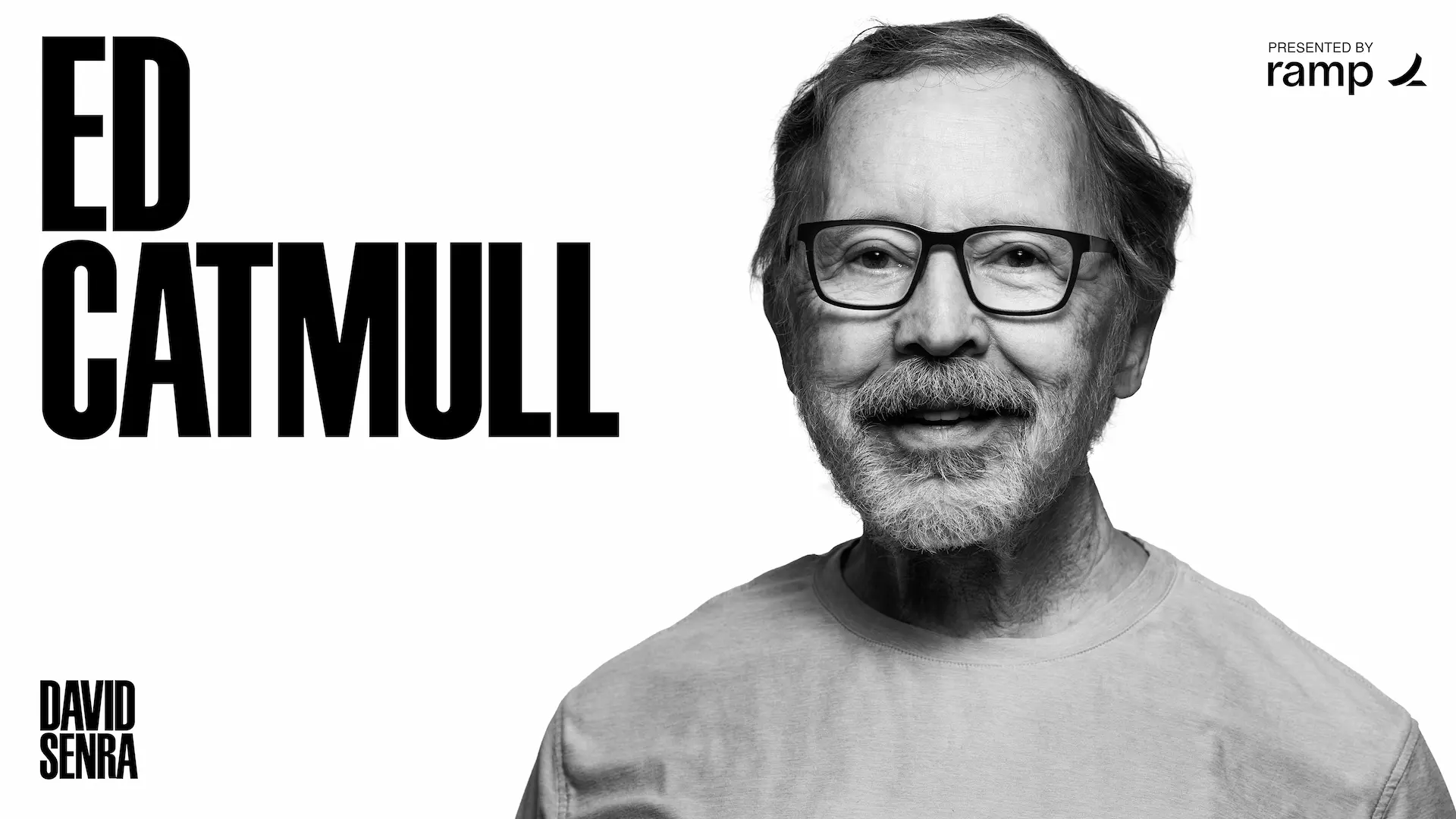
Ed Catmull
Ed Catmull is the co-founder of Pixar and former president of Disney Animation.
Summary
Ed Catmull is the co-founder of Pixar and the former president of Disney Animation.
He grew up in 1950s Utah wanting to animate for Disney. Convinced he couldn't draw well enough, he studied physics and computer science at the University of Utah instead, landing in one of the great talent incubators in computing history. In 1972, he animated his own left hand—one of the first 3D computer renderings ever made. Since childhood he had carried a single ambition: to make the first feature film animated entirely by computer. Reaching it took more than 20 years.
George Lucas hired Catmull in 1979 to build a computer division at Lucasfilm. When Lucas needed cash, Steve Jobs bought that division in 1986 for $5 million and spun it out as Pixar. For years it sold imaging computers and lost money while Catmull and John Lasseter made short films to keep the dream alive. Jobs sank roughly $50 million of his own money into it. In 1995, Pixar released Toy Story, the first feature animated entirely by computer, and went public days later. Finding Nemo, The Incredibles, WALL-E, and Up followed. Disney bought Pixar in 2006 for $7.4 billion and put Catmull in charge of both studios; he revived a faltering Disney Animation with films like Frozen.
Catmull cared about the conditions that let creative work survive its own fragility. Every original idea, he argues, starts out ugly and broken, and management exists to protect it long enough to get good. At Pixar that meant the Braintrust: a room where directors got blunt feedback with no authority attached and the conversation stayed on the problem, never on who was right. He laid it all out in Creativity, Inc.
Episode transcript
David Senra: Right before we started recording, you said that you had some Steve Jobs stories and that you had wanted to add something to it. What were you going to say?
Ed Catmull: Well, this is a result of just thinking a lot about the last many years as we were... And a lot of it's reflection, but also trying to understand the nature of change and the process that you have of trying to come to an understanding or gain insight. In the book, I talked a lot about the Braintrust. The Braintrust is such a mechanism.
Ed Catmull: Different companies have different ways of trying to arrive at the truth and getting insight out there. Every company says they do that. Most of them are full of shit. All right. What they've got are people around them who are telling them what the leader wants to hear, and the leader thinks, because they're hearing what they want to hear, that he got this really insightful group. But it's not really about diving deep.
Ed Catmull: There's an overlay of the politics and where I am, what's my career, and so forth, all of which gets in the way. In the case of the Braintrust, we worked out a way for people to be honest with each other and feel comfortable about it. And we thought a lot about how to do that and what the personal dynamics are, what the psychology is that might get in the way, and how we address it.
Ed Catmull: But Steve had a very different approach in order to get insight, and I would say the others do too, so it's just like the different ways of doing it. But he did understand what he was trying to do. He did understand at an intuitive level, there's no upside in being wrong. As soon as he understood something, he would change quickly.
Ed Catmull: But here's the thing that most people don't know about, and that is that Pixar was a public company for 10 years, starting in '95, when we went public, until 10 years later, when we were acquired by Disney. In that 10-year period, Steve fired two members of the board of directors at Pixar.
Ed Catmull: The reason he fired them was that they never disagreed, and he said, "If they don't disagree with me, then they aren't bringing any value to the company." That's an unusual way of thinking, and he really believed that. Our board meetings were lively; they were loud, and they were thrilling. And you know, we made great progress.
Ed Catmull: And they were arenas of disagreement, and these were people on... The rest of the people on the board had very strong opinions, did not agree, and Steve loved that. And I would say, a lot of executives probably say they want that, but Steve really meant it. He and I disagreed a lot. We didn't argue. We disagreed, and we'd have week-long discussions about something.
Ed Catmull: And in the end, about the third time, I would realize he was right, and about a third of the time, he would realize I was right. But the other third of the time, I just did what I wanted, and he was fine with that because we had discussed it.
Ed Catmull: The whole point is, how do you get to the insight? How do you surface things? Because it's hard to get underneath things. I would say that a lot of people like to go down one layer. You go down the one layer, and you form a decision. You can't do that. You've got to keep peeling away the layers to figure out what's really underneath it. And it's a shortcut to make a decision quickly based upon a little bit of information.
Ed Catmull: And getting at underlying factors is inherently a long-term strategy, and it's a difficult one, and it's timely, and you need different mechanisms within an organization in order to get to better insight.
David Senra: What are some of these mechanisms? Because Steve has famously said, and I've heard a few other people say this, that he learned more about the art of management from you than anybody else that he ever met.
Ed Catmull: Boy, he didn't tell me that. I would say we were just completely different.
David Senra: But what are these mechanisms you're saying to get to these other levels that you used?
Ed Catmull: Well, one of them is that the discussion is always about the topic. It isn't about who's right. So, for me, the example would be in a healthy Braintrust meeting, because you've got people working on a film. So, what are the dynamics when you come together as a group in order to discuss something, and you're discussing something that has problems?
Ed Catmull: Just the nature of all these films is that it may be a great idea underneath it, but it's not gelling, or it's not working right. The creative team presenting it knows that it doesn't work, but it also means they're vulnerable. They feel vulnerable, and they're presenting it to their colleagues and people who are very successful.
Ed Catmull: So, if you're aware of that, then you can actually give them space in order to listen, because that's what we really want is for them to listen. But there are other dynamics that are going on. There are people in the room who may be new to the room, and they may want to demonstrate that they're capable of contributing.
Ed Catmull: So, if they put out an idea and it doesn't work, then they may feel like they've embarrassed themselves or they haven't shown themselves worthy. They're now thinking about their relationship to it, rather than about the problem. So, that's a psychological thing that happens in the group. I throw out an idea. Is it accepted or rejected? That becomes a personal thing.
David Senra: Well, how do you manage that? How do you avoid people not saying an idea, like letting potential embarrassment stop them from sharing an idea?
Ed Catmull: Well, the original group started off as a small group who were already all that way. And they're starting on "Toy Story." They'd had these intense discussions, and it was really about solving the problem.
David Senra: So, they didn't have any fear of embarrassment?
Ed Catmull: No, it was like a forum.
David Senra: Okay.
Ed Catmull: So, they're working together on the same thing, and their very nature is that they're working on the problem. When we started, we had that group that worked together, but we also had something else that, I think Andrew Stanton and I recognized, I think, most clearly, was that we had an outside force that was a corrective.
David Senra: An outside force?
Ed Catmull: An outside force.
David Senra: Okay.
Ed Catmull: Because our contract was with Disney, and so, the person who was in charge of Disney Animation at the time was Tom Schumacher, who later moved back to Broadway to be over theatrical there. But he would come in as a person who had a vested interest in our success, and he would tell us what he thought, and often he would disagree with what we had. So, it was good to have someone come in.
Ed Catmull: It's like a different perspective in case you get caught in a little loop because you're building this thing in your head. It's kind of fragile, and sometimes you need somebody to say, "Well, that's not working," and jar you from that fragile thing that's in your head. He would only see it once in a while, and we valued that.
Ed Catmull: "Bug's Life" was the next film, and then "Toy Story 2" as the next one. The first one was just obviously was the first. Like, that was getting going, but we were getting our legs under us as we figured all of this out. We also had a group of people who were consciously trying to figure out the process. It was just everything about it, not just the movie, but how we worked with each other.
Ed Catmull: But as we were getting better at this and starting to rise, and by this time we're a public company distributing through Disney, Disney was starting to go downhill. And we are aware that Tom Schumacher was going to leave because he was going to New York, which meant we were going to lose our outside force.
Ed Catmull: Andrew came up with the idea that this group that we had, we would call the Braintrust, and that as we elevated other people to become directors, we would bring in others, or the writers or certain experienced people, into a room. It was a smaller group to solve the problems, but the Braintrust would then see somebody else's film and act as an outside force. That was the idea.
David Senra: So, other directors looking at another director's film and giving feedback.
Ed Catmull: Yes. Now, it was to replace what Tom Schumacher was doing. It didn't work. The problem was they weren't outside. They're in the building. They're all the time, and they always know what's going on. So, the notion of them being on the outside isn't true.
Ed Catmull: However, what we discovered was they had this immense capability of giving ideas to each other and helping each other, which wasn't the same thing. And it's a subtle difference to have this outside force. Instead, it was this problem-solving group. So, the Braintrust was a way of running a certain kind of meeting, for every screening of a film or occasionally at an offsite.
Ed Catmull: It wasn't that we ran every meeting, because they have different dynamics. It was a particular thing that took place after a screening, and everybody learned how this worked. We had to get another outside force, and the outside force was Steve Jobs.
David Senra: Because you banned him from being part of the Braintrust, correct?
Ed Catmull: Yes.
David Senra: Why?
Ed Catmull: Because he would not be an outside force. In other words, as a... He is now on the board, and he sees it once per screening, so he doesn't see it very often. And now, he would come into this meeting, and he's fresh. He hasn't seen anything since the last one.
Ed Catmull: He would usually call me the morning of. I was in my little gym, in my home, working out, and I'd get a call in the morning. I could count on it. And he'd say, "How's it going, Ed?" And I'd say, "Well, I think we've got problems." "Okay, nice to know. I'll see you later." I would never tell him what to think. All right? That was part of the relationship. Steve was smart enough that I could say there's a problem or that I think there's something, but I was not going to tell him how to think. Or I might say, "I think it's going pretty well." "Nice to know. I'll see you later today." That was it.
David Senra: What do you think was the purpose of that phone call?
Ed Catmull: He knew, because I'm in the middle of this, that if there are problems in there, that there is a need for someone to come in and say something strongly. But at that point, it had to be from him.
David Senra: Because it couldn't be to him, right? Were people afraid at Pixar to share harsh feedback or fight with Steve?
Ed Catmull: No, not with Steve.
David Senra: Okay.
Ed Catmull: No, it was...
Ed Catmull: Actually, people, they would talk back with him. I mean, was there a little bit of fear? And he was obviously so well known that a lot of people were nervous. I mean, there are people who are nervous about me too, just because of the position.
David Senra: Yeah.
Ed Catmull: That's just a reality, is when you're in a position of either power or perceived power, that people react to you in a different way, and it's critical to be aware that that phenomenon takes place. Because nobody will tell you that, right? They wouldn't admit it, but it happens. So, if you're aware of it, then you can just sort of be a little more tuned in.
Ed Catmull: There was another reason why he didn't go to the Braintrust meetings, is that in order to get the dynamics right, that the people with power, either real or perceived power, needed to shut the hell up for the first 10 to 15 minutes.
David Senra: And he couldn't do that?
Ed Catmull: It wasn't that. The logic of that is if a person with power speaks, they tend to set the tone for the rest of the discussion. So, you don't want them to speak at the beginning. You want the discussion to start, and then you enter the discussion, but in this case, they're entering as filmmakers with the others, and it doesn't derail the discussion.
Ed Catmull: Steve had such a powerful voice that it didn't matter when he spoke. He was going to have this extremely strong effect on the dynamics of the room, and he understood that, so it was the reason he didn't come. I said, "Basically, the dynamics don't work if you're in the room, and that we need you for this." And he understood that, and that's the way it worked, and it worked great.
Ed Catmull: It was an interesting phenomenon because Steve would come into the meeting that the Braintrust... Or excuse me. It wasn't a Braintrust meeting now. It's the meeting of the board of directors. That's when he would see it. The whole board of directors would see it in the theater with a subset of the company. We didn't have the whole company see it all at once. It was always trying to make sure there were some fresh people, or people who hadn't seen it before.
Ed Catmull: So, there'd be some audience there. But really, at the end of it, the board of directors would come together with the filmmakers, and each would give their comments. And Steve would give his comments. He was extremely articulate, and he would give his notes, and most of the directors would say at some point that Steve gave them notes, and he saw things in the films that nobody else saw, that they'd never heard before.
Ed Catmull: However, I'm in every one of these meetings. There was nothing that Steve ever said that had not been said by somebody else before in one of those meetings. Now, what's the difference?
David Senra: What's happening there? Explain that.
Ed Catmull: Well, part of it is that when you know somebody really well, then you can also learn how to disregard what they say. They're saying the sort of thing they might be expected to say, and you disregard it, or you don't hear it. With Steve, it wasn't possible to do that. He was so clear and articulate that saying the same thing would actually break through in ways that you wouldn't hear from the others.
Ed Catmull: And there are a couple of examples of them, and I can't actually tell the story because of the people involved. But sometimes people felt betrayed because their colleagues hadn't told them about the problem before. But they had. As I say, I was there, and I heard all this, and they all felt like they were not being listened to. And then Steve came, and all of a sudden, the director hears that, and now it's a new revelation even though it's been there all along.
Ed Catmull: That's the reality of people with strong opinions of the dynamics, and I... Honestly, my job there, while it was fun to give notes, my job was to look at the dynamics. And I will tell you that in general, this worked very well. Everybody figured this out that this is how it works, and it was great, and they loved it. And even though there were apprehension, they wanted the notes, and they engaged correctly with it.
David Senra: I want to tell you about the presenting sponsor of this podcast, Ramp. I have been reading a lot about SpaceX lately. SpaceX is one of the most valuable private businesses in the world, and one of the main themes in the history of SpaceX is constantly attacking and questioning your cost. Ramp helps many of the most innovative businesses in the world do exactly that.
David Senra: The median company running on Ramp cuts their expenses by 5%, and one thing SpaceX has demonstrated is that a religious dedication to controlling costs can help actually increase revenue because you can pursue opportunities you couldn't otherwise, and we see that in the Ramp data too. The median company running on Ramp also grows their revenue by 16%. So, when you're running your business on Ramp and your competitors are not, you have a massive competitive advantage that compounds over time.
David Senra: Ramp is the only platform designed to make your finance team faster and happier. Many of the top founders and CEOs I know run their business on Ramp. I run my business on Ramp, and you should too. Go to ramp.com to learn how they can help your business save time, save money, and grow revenue. That is ramp.com.
David Senra: You're running the company. Steve's there almost never. I've never heard anybody, a CEO, describe their job as, your job is to observe and manage the dynamics. What do you mean by that?
Ed Catmull: Well, in the case of, let's say, the Braintrust, just as an example, is that in general it works pretty well. Every once in a while, you go off the rails, and to go off the rails, and then you have to figure out why it went off the rails, what got in the way, and then usually you have to reconvene with a smaller group, because the dynamics, as we all know, are different when you've got a small group.
Ed Catmull: If things are going well, you like a bigger group because you're training other people to feel comfortable in this way of working. But if the problem is really serious, when you go to a smaller group, where they're sort of past that stuff, and they can focus on the problem. So occasionally, it's off the rails. Usually, it works very well, and once or twice per film, then magic happens. By magic, I mean that ego has left the room.
Ed Catmull: You have these intense discussions, and somebody can say something, and it doesn't work, and they're not thinking about my idea wasn't there. They're always back on the problem. And it's described in sports as flow, or in areas like that as flow, but it's like a group getting into that state. And that's the ideal place to get.
Ed Catmull: This is so important to get this, all this working right, that this is what our product's based upon, is this group of people working well together. So, paying attention to the dynamics of those rooms is the job. They're the ones that are making the movies. I'm not making the movie. I'm just trying to make sure they work well together. From the point of view of directing a company, like a board of directors, how do they work together?
Ed Catmull: And sometimes the board of directors are there, and the CEO just wants sort of protection from them doing it, so he wants to craft everything that goes to the board of directors. It's not the way Steve worked.
David Senra: What is the way he did it?
Ed Catmull: Well, it was just like we knew what the problems were. We'd come in, and you'd have these people with very strong opinions. Well, we had the number one attorney from Silicon Valley with us, Larry Sonsini, at the time.
David Senra: Apart from who was on the board, how did Steve manage the board differently than other CEOs?
Ed Catmull: We had a few of the critical issues out of the company. We were a production-only company. All of our films were marketed through Disney. So, and then there was a limited time span in our contract with Disney. So there are a number of things we have to do to figure out where the company's going, what the relationship is, how do we make it strong, or where is it threatened? And at the time, through a lot of this time, Michael Eisner was the CEO, and the CEO of Disney, and Michael Eisner did not get along well with Steve.
David Senra: Steve hated him?
Ed Catmull: The real reason for that, well, there were two things there. One of them was that Michael testified before Congress about ripping, because there was some testimony about it with audio. Yeah.
David Senra: Ripping?
David Senra: What's ripping?
Ed Catmull: Copying video onto... If you got a audio on a CD or something like that, and you transfer it onto your computer. So, it's a name for copying something.
David Senra: Okay.
Ed Catmull: But it sounds like ripping off. So, which is an unfortunate use of the term. So, Michael Eisner was testifying against without knowing what the term actually meant. So, it was upsetting to Steve.
David Senra: Why was that upsetting to Steve?
Ed Catmull: Well, but see, it's a congressional thing about the technology and how it's being used. Only now Congress is getting misinformation. But the other one was that our contract with Disney, an initial contract, was to make three movies.
Ed Catmull: And at the time it was signed, Disney perceived that Pixar was going to produce boutique films, their word, much as they would consider "A Nightmare Before Christmas," a stop-motion animated film, to be boutique.
David Senra: And therefore, not bringing that much money at the box office.
Ed Catmull: That's right. In other words, they were going to spend a lot on it, and they thought, well, that short film wouldn't scale up to be a feature-length film. I mean, you couldn't really watch the computer graphic stuff for that long of a period of time, but it's like stop motion. It's a little quirky.
David Senra: So, that's what they went into the first deal with, thinking limited potential here, not knowing that "Toy Story" is going to come out, win all these awards, and be the highest-grossing film of the year.
Ed Catmull: That's what they were thinking.
Ed Catmull: That's right. So, that was a leap because it was quite... It was unlike the things that they've been doing.
David Senra: So, Steve thought Eisner gave him a bad deal.
Ed Catmull: Well, it's not a very good deal. So, Steve walked away feeling like it was one of the worst deals he's ever struck.
David Senra: This is where he comes to you with the saying, "We're going to..." So, you guys essentially bet the company on "Toy Story." You were in dire financial straits. We're going to bet everything on "Toy Story," and the same week that "Toy Story" is going to be released in theaters, we're going to IPO.
Ed Catmull: Yes.
David Senra: Is that correct?
Ed Catmull: Yes.
David Senra: What was your response when he first came, and talked to you about this idea?
Ed Catmull: Well, I mean, I thought it was crazy. I learned a lot in this process. He was right. But he had a logic, and the logic that he gave at the time was that because we knew this was not a boutique film, this is going to be a big deal. After this film, we had to deliver two more films, but at the end of delivering the next two films, because now we had the experience that nobody else did, and we got those other two out with all the experience behind us, that when we're done, that we would have created Michael Eisner's worst nightmare: a competitor.
David Senra: Which was funded in part by Disney, funded their own competitor.
Ed Catmull: Yes. And he said, "And Michael cannot let that happen, so Michael will want to renegotiate the deal." At this point, and this is part of the change in Steve's life, because he would typically shoot for the moon on a lot of things, at Apple and at NeXT, and often overshoot. But he recognized it because he's very smart, and so, what he said at the time was that if we renegotiate, then we have to come in as equal partners.
David Senra: Which means we need money, which we don't have at the time.
Ed Catmull: Yes. So, we have to go public to do it. It was very compelling, and it also turns out to have been exactly what happened. So, that was fine. So, we negotiated a new deal, and the new deal was now a five-picture deal, but sequels didn't count. So, if we made a sequel, and the idea was there'd be a sequel to "Toy Story..."
David Senra: Why would sequels be excluded?
Ed Catmull: Disney wanted to get as much as they could, and that was their way of differentiating between an original film and one that was presumably easier to make. So, that was the assumption. The second is that Disney had been selling sequels on VHS at the time. Until that time, the only theatrical sequel that Disney had ever made was to "Rescuers Down Under."
David Senra: Hmm.
Ed Catmull: That was four. "Rescuers" was the original. "Rescuers Down Under" was a sequel.
David Senra: Did that movie do well? Because I've never even heard of it.
Ed Catmull: Well, the answer is no. But it also should be noted, it is the first motion picture where every frame went through the computer. It was using the paint system that we had developed under contract for Disney. So, this is part of our relationship; we wrote the software. It was used on "Rescuers Down Under," the whole thing. It looked great. The reviewers said it looked great, better than looking through the acetate.
Ed Catmull: The story was only so-so. Didn't do all that well, wasn't noticed, but they then had the confidence to really go all out on their next film, which was "Beauty and the Beast," using...
David Senra: That one I'm familiar with.
Ed Catmull: Yeah, using the same software. "Beauty and the Beast" came out in 1991, a pivotal year, which we should come back to in a minute. But in '91, "Beauty and the Beast" came out. It also had some 3D graphics in it, but largely it was the painting of the cells with the CAPS system, which was written by Pixar under the contract. Disney had some people who were working on that system also.
Ed Catmull: And they got an Academy Award for it, for what it... But the film itself was a theatrical sequel. So, Disney did not perceive of a sequel as something which was worthy of going out in the theaters. So, when we had the deal to make the additional films, then sequels were now perceived as not at the same level of quality or anything else as a theatrical release.
Ed Catmull: So, that was the logical rationale for it. At this point, we're now working on "Bug's Life." We're already working on it. We started working on the sequel to "Toy Story," and I knew we had a problem even before we started. I thought, "There's something about this which is wrong," because we're building a company, and everybody has a belief about the quality that we shoot for. Because we released "Toy Story," we were proud of it.
Ed Catmull: Now, we're working on "Bug's Life," and we're trying to make it even better just in every way that we can. And now, we start another film, which is supposed to be lesser because it's going direct-to-video.
David Senra: Yeah. Originally, "Toy Story 2" was going to... Disney wanted you to just forgo theaters and release it direct to video.
Ed Catmull: Yeah, that was the plan. That was one of the reasons why it wouldn't count. So, we almost immediately said we think it needs to be theatrical. Disney didn't push back on that at all. I mean, they agreed that it should go theatrical. But it didn't change the terms of the contract. It just came out, and then it turns out it was a huge success. And once it was a huge success... Well, the thing was, though, it was the first animated successful film of any kind ever.
David Senra: Yeah, for a sequel.
Ed Catmull: Basically, it changed things. Now, of course, it's common for there to be theatrical releases or theatrical sequels.
David Senra: Yeah.
Ed Catmull: But at the time, it was a sort of breakthrough. It changed everybody's mind because it never happened before. So, the issue now came with "Toy Story 3," because "Toy Story 3" would be a sequel. And Steve said to Michael, "Michael, we're a public company. Our investors are expecting that the... We're coming to the end of the contract. And it's no longer true that this is just a sort of second-class sequel, that this is really a first-rate theatrical film, and it should count."
Ed Catmull: And Michael stuck with the letter of the agreement. That's what pissed him off. But it pissed off Steve. So, it was just sitting there, and the deal was that if we wouldn't make it, they could. So, at some point, a few years later, they started to make their own version of it.
David Senra: Which would kill the morale on your team because they don't think of these people... The amount of effort and energy they put into the character is almost like your child. It's like saying, "Now somebody else is raising my child."
Ed Catmull: Yeah.
David Senra: And they're going to do a terrible job. They're not going to do a better job than John Lasseter, and Ed Catmull, and the talent that you have at Pixar.
Ed Catmull: It put in that strain between them. Now, our relationship with the studio and with marketing was very good, so that was between Steve and Eisner.
David Senra: Did it strain your relationship? Did it change the way you viewed Michael Eisner? Because I know Steve's pissed off, but aren't you as well?
Ed Catmull: Oh, yeah. Yeah.
David Senra: Okay.
Ed Catmull: No, I was not a fan of his. A war was now brewing between Michael Eisner and Roy Disney, who didn't like what was going on there.
David Senra: And Roy was on the board of Disney.
Ed Catmull: Roy was on the board, but was forced off.
David Senra: Yeah.
Ed Catmull: And when he was forced off, that's when this war took place, because he still had a lot of shares in the company, and it was very public. There was a book written about it.
David Senra: Yeah, me and my partner Rob, have been reading the book. Why can't I think of the title?
Ed Catmull: "DisneyWar."
David Senra: There you go. There's a war about it. It's called "DisneyWar."
Ed Catmull: You've got the book there, yeah.
David Senra: Yeah, it starts out with Roy and something about a Ferrari.
Ed Catmull: They wanted to interview us, and none of us would talk with the writers of the book. And the reason was that we didn't know how this was going to end up, but we didn't want to screw up the relationship with the other people. None of us said anything. So even the parts of it which are about Pixar are the things about Pixar perceived through the Disney lens of the people who were there. It wasn't bad. I mean, it just was...
David Senra: So yeah, in that context, Eisner is fighting multiple wars on multiple fronts because he's also got this war with Steve Jobs going on at the same time.
Ed Catmull: Well, that's a personal thing.
David Senra: Yeah.
Ed Catmull: From the point of view of Pixar with Disney, there isn't any war going on there.
David Senra: Yeah.
Ed Catmull: We're basically neutral in this.
David Senra: But what is your reaction to this when they make this decision for "Toy Story 3"? Is this when Steve says he's breaking off the... Because there was a time period where Pixar breaks off the negotiations with Disney completely. Is this the same time?
Ed Catmull: Well, no. What's happening is we're just getting near the end of the contract. But we're getting close to delivering the last film, and at which point Steve would not have let Pixar stay with Disney. Steve, at this point, also knew that he had cancer.
Ed Catmull: It was an emotional time lesson, which it's actually when he showed us the first iPhone when it was a secret, and we're on this bridge between the one building, and there's a bridge over that goes between another tall building next to it. And the secret lab is where they're designing it.
Ed Catmull: And he told us that he didn't know how long he was going to live, and he lived several years after that, but he wanted to make sure that his family was taken care of. He wanted to see his son graduate from high school, and he wanted to make sure that Pixar was in good shape. It was very emotional at that time.
Ed Catmull: Michael Eisner was still the CEO, and he would not have continued with Michael Eisner. So, since we were getting near the contract, he started discussions with other studios, which would mean them doing the distribution. The fact is, Disney is the best at marketing films, including internationally.
Ed Catmull: We started those discussions, and then the war over Michael Eisner got really heated up, and they voted him out, but then they went through this process of who were they going to select. Bob Iger was in that group.
Ed Catmull: Steve had talked with Bob Iger in the past, because at the time he was like the COO, because Michael Eisner was busy fighting out this major lawsuit he was in with Disney and the board and all that. And they finally made a decision.
David Senra: Once he takes the CEO role of Disney, and if I remember correctly, yeah, Bob Iger had said when he knew, the first person he called was his daughters, and the second person he called was Steve Jobs.
Ed Catmull: The night before.
Ed Catmull: Yes. So he called Steve at his home on Sunday night and said, "Tomorrow it's going to be announced that I'm the new CEO, so this needs to be confidential until that time." He said that he's been to all the parks, and he knows that all the new material is coming from Pixar.
David Senra: There's actually an interesting story about that, where, I think this might have been in Bob Iger's book, might have been in yours too, where he's standing next... This is before he's CEO of Disney.
Ed Catmull: It'd be in his book.
David Senra: Okay. He's standing next to Michael Eisner. I think they're at Hong Kong Disney, and Michael's like, "Let's watch the parade," the parade that happens every day. And all the characters are going by, and he realizes every single character that is popular in the parade was created by Pixar and not Disney Animation, and that's how he knew, "No matter what, I cannot let Pixar get away."
Ed Catmull: What happened when he called Steve, because he told Steve that, but then he said that he's been to Disney Animation, and they say that they've got it almost fixed. Essentially, they've found what the problems are, and they're about back on track.
David Senra: And you would have called that bullshit at the time?
Ed Catmull: What Bob says is he did not believe that they were nearly fixed.
David Senra: And you didn't believe it either?
Ed Catmull: Oh, no, I knew it wasn't.
David Senra: Okay.
Ed Catmull: I knew. They didn't have a shot at it. But he knew it, and he told Steve that he didn't know how to find anybody, and the only ones he knew who knew how to run animation now was Pixar. "So can we talk?" And Steve says, "Yes, as soon as you're ready." So that was their conversation.
Ed Catmull: Steve was blown away because Bob Iger starts the conversation by saying, "I've got a crappy hand. Can we talk?" And for him, it's like that's a show of honesty that's unusual.
David Senra: Usually, you don't start a negotiation by saying, "Hey, other party, you have all the leverage here."
Ed Catmull: That's right. Bob just started off by being completely honest, and Steve said, "Okay, this is somebody I can be a good partner with." And they formed a very close bond and relationship throughout the rest of Steve's life.
David Senra: And Bob's solution was, "We want to buy Pixar."
Ed Catmull: Yes. But that's the first thing he wants to do, and he talks about it in the book because the board does not want it. But here's what we see is, and I will say incidentally, up to this point, we're now almost 15 years since our original signing of that first contract with Disney in 1991. That contract gave them the right to look at everything we did and all of our processes.
Ed Catmull: As we started to become successful, nobody from Disney ever came and said, "What are you guys doing?" Now they're starting to go downhill. Their last really big hit was "Lion King," then it started to go down from there. We're going up, and we show them the films.
Ed Catmull: We take them down and get notes from them and so forth, but nobody ever asks what we're doing or what's different or why is it that Pixar is so different. It was very curious. So now for me, it's just observations like, "Okay, why aren't they curious? Why aren't they asking?"
Ed Catmull: Then we sign the contract, the five-picture contract, to continue it, which continues that right to see everything that we're doing. Now we're very successful, and they're very unsuccessful, and still nobody ever asks, "What are you doing?" And there are no secrets. We're not hiding anything ever.
David Senra: What's going on there?
Ed Catmull: I have a theory. Part of it, I think, this has to do with, you go to your first conclusion, and you stop thinking. In this case, they would have thought that the reason Pixar is successful is because they've got some combination of, John Lasseter's got it, or John and Ed, or John and Ed or Steve, some combination of the three.
Ed Catmull: We don't have them, and that's the secret to their success. So we can't copy that. Now that's just a shallow way of thinking. The real question is, what is it that's being done that's different? Everybody's different, but what are they doing? And there was a logic behind the way we built Pixar and the culture at Pixar, which is unlike anything else in the entertainment industry. There's nothing secretive about it. Nobody cared to know.
Ed Catmull: Bob decided to come up as soon as he was made the CEO. He came up to Pixar, and the idea was to spend a day with us, seeing what we were doing, how we thought about things, and what we had in the works. And when he came, he walked up our walkway to the building alone.
Ed Catmull: No assistant, no entourage, a driver dropped him off. He came up alone, spent the whole day going around. The first thing is, from the people at Pixar, the fact that he came alone was very impressive, right? No group of people coming around, so very personal.
Ed Catmull: Bob loved what he saw, and then he went back, and he said, "Okay, we have to do this." And that was his first major battle with the board, which he did write in the book. He said, "This was too big of a risk and too much money."
David Senra: What did he see that day that made him arrive at that conclusion?
Ed Catmull: He saw the way we worked, the interaction, the ideas that we were working on, the style... And honestly, the way I look at any film that we're working on is, when we're working on a film, and you've got a group trying to solve the problems, and as I've said many times, when you start off, these films aren't done. They're beginning. They have many problems. They suck and all sorts...
David Senra: I think in the book you say, "Embrace that early work will always suck."
Ed Catmull: Yeah, so basically, if that's true, then how do you measure whether or not you should keep doing it? It sucks. Well, let's keep on doing it. So, what's your basis for proceeding? And for me, the basis was, what's the spirit of the team?
Ed Catmull: Because we all know it doesn't work, but if they're really working together, and they're laughing, and then they're angsting and all that together, then that's when you say, "Okay, we just keep going. We just keep trying to solve it." Along that line, before I left, we completed 21 of the 22 films we started.
Ed Catmull: So, this is bizarre in that world. And at Disney, we completed, by the time I left, 10 of the 11 that we'd started. So it was just a different way of thinking about it if we're going to fix the problem, and a hard problem is more likely to lead to an interesting film.
David Senra: Say more about that.
Ed Catmull: Well, if it's easy, then essentially, it's more derivative. You know how to write a script, you know what the three-act structure is, you know all these elements of storytelling, and you put together all the pieces, and you've got a story. Is it a great story? Is it emotional? Well, sometimes yes, sometimes no, but the statistics actually aren't terribly good. But it's fairly easy to come up with something which is mediocre. It's cheaper, too.
Ed Catmull: If you take on hard things, then you need to spend more time trying to figure out how to be different in what you're doing. So if you take on a hard problem and you just keep pushing at it, then the fact that it was hard is what's going to make it different. So if you're going to make a movie about a rat that wants to cook, all right, that's not a slam dunk.
Ed Catmull: Not only that is, a lot of people want to keep their project secret. This is one where you could tell everybody, "We're going to make a movie about a rat that's going to cook." Nobody's going to copy it. But what is the measure? Because sometimes things don't go right. So, we will change up people.We've changed out some directors.
David Senra: Including on "Toy Story 2." Was that the first time you changed directors?
Ed Catmull: Yes. Because the reasoning is that the one thing that the director can't do, they can screw up in all sorts of ways, but they can't lose the team. That was our guiding line. If the team is together...
David Senra: You mean the team's lost faith in the director.
Ed Catmull: In the director, right. Then our phrasing was, "The director can't lose the team." But we're doing everything we can to help them, because sometimes you've got new directors, and sometimes these are really good people. You gave them the position because you believe they could do it.
Ed Catmull: And even though they've been close to it, and they've watched it, holding the mantle is a different kind of thing, and it's pretty difficult. It isn't like, let's say, baseball, where you can give credit to the starting pitcher and the middle pitchers and the relief pitchers, and they all get credit. With directors, everything sort of goes to the final name that's up there. The reality is, everybody was contributing, even that first person that was there.
Ed Catmull: It's really hard on people to do that. So most of the behind-the-scenes work is to shore them up, help provide guidance, because you really want everybody to succeed. But if they lose the team, then we have to make a change. But the result is we push things all the way through. And in the case of... I said we completed 21 of the 22 films we started.
Ed Catmull: What's the one film we didn't finish? Well, that one we actually did assign to another director to complete, and he took a pass at it. And this was Pete Docter, and Pete said, "We're getting this film going now. It's such an uphill thing that there's actually an idea that I have that's been rolling around in my head that I think might be better, and it takes place inside the mind of a little girl."
David Senra: And this is "Inside Out."
Ed Catmull: Yes. So we said, "You're right." But also, you're relying on the passion. So Pete Docter, who's very well loved at Pixar, and he wants to tell this rather emotional film, and we say, "Okay, we're in." So, 22nd became one of the other films that was completed. But that's just the process. There are no real strict rules. We're just trying to get to the quality, and we're trying to get it to work and have those teams work.
David Senra: I found one of my all-time favorite quotes when I was reading the book "Zero to One." The quote says, "The single most powerful pattern I have noticed is that successful people find value in unexpected places, and they do this by thinking about business from first principles instead of formulas." That is exactly what AppLovin has done with their advertising platform, Axon. Axon connects you with over a billion potential new customers inside mobile games. Axon allows you to capture undivided attention.
David Senra: Axon ads are full-screen video ads that are watched for an average of 35 seconds. That is retention that blows other ad platforms out of the water. You can launch on Axon in minutes. You set the goal, and Axon achieves it. There's no complex setup, no expertise needed, and Axon scales quickly. They can put your ads in front of over a billion potential customers.
David Senra: Other businesses have seen immediate results, have scaled to hundreds of thousands of dollars of spend per day, and increased their revenue by millions. So you want to get started quickly before all your competitors are on Axon, and you can do that by going to axon.ai/senra. That is axon.ai/senra.
David Senra: When you do that switchover from "Toy Story 2," John Lasseter was put in charge of that movie, if I'm not mistaken?
Ed Catmull: Yes.
David Senra: And that's when you come up with this mantra that you would repeat inside Pixar, which, I think, comes directly from John Lasseter, where he said that quality is the best business plan.
Ed Catmull: I like what he says because... Although it wasn't the mantra for the rest of the studio, but it was like an implicit one.
David Senra: It was his one.
Ed Catmull: Yeah. Part of it is that my own personal belief is we never had a mission statement. And the reason for not having a mission statement, and I don't want to generalize to everybody else, but a mission statement is an answer when typically we should always be asking questions, "What are we doing?"
Ed Catmull: And if you immediately say, "Oh, well," you go back to the mission statement, "We're doing this," it actually ended up being stronger to have it so that there was always sort of this questioning, "Are we doing the right thing, and are we going in the right direction?" We always had that question that was going on.
Ed Catmull: But in terms of quality is the best business plan... This is related to this great book, "The Man Who Broke Capitalism," about Jack Welch.
David Senra: Oh, okay.
Ed Catmull: Great book. And I think the year 2000 is when Forbes magazine had named him as the CEO or manager of the century. Utter disaster.
Ed Catmull: People who were there... Because they had this really high compound growth rate for 10 years, something like that. So people who were raised under the system were considered to be the very best, whereas General Electric today is split up into pieces.
David Senra: Yeah.
Ed Catmull: And it was completely fragile, not robust, because he gutted it of the future research. But the people that were there were hired and considered to be valuable because they'd grown up in that system, two of them which went on to become leaders of Boeing, applying the same principles they learned from Jack Welch at Boeing, with the consequences that we now see.
Ed Catmull: And the opposite of quality is the best business plan, because the reality is that quality in products, whether it's phones or movies or airplanes, the quality is very important. That is kind of inherent in the business plan. But too many, it was the short-term annual growth rate.
David Senra: Yeah. Which is the opposite of what Lasseter is preaching in that statement.
Ed Catmull: That's right. We were not the lowest-cost producers of animated films, that's for sure. We may have been even the highest cost.
David Senra: I want to pick your brain about... You had two childhood heroes you write about in the book, one being Albert Einstein, the other one being Walt Disney. I've read everything I can get my hands on on Walt Disney. I find him fascinating. And him and his brother would fight over this, because his brother was the one supposed to be in charge of the money, and Walt was the innovator. And he's just like, "How much is this going to cost?" And they would have this argument, and he goes, "We're innovating. I'll tell you when I'm done."
David Senra: Like, "I don't know what the cost is. I'll figure it out at the end. I'm not trying to make the lowest cost product. I'm trying to make the best." So what are some of the things that you learned from Walt Disney that you think you apply to Pixar?
Ed Catmull: Initially, as a kid watching that, what I'm seeing is the result. Now, as an adult who's...
David Senra: What do you mean you're seeing the result?
Ed Catmull: In other words, I'm watching the movies and going to Disneyland as a kid.
David Senra: And then also watching... What was the show he was doing for ABC when he's talking about building Disney, the first Disneyland? It was "The Wonderful World of..."
Ed Catmull: I think it was "The Wonderful World of Color" because I think when it first started, it was "The Wonderful World of Disney" or something like that, but when color TV became popular, they changed it to "The Wonderful..."
David Senra: And you were like nine years old or something like that, watching in your living room.
Ed Catmull: Yeah, something like that.
David Senra: Yeah.
Ed Catmull: Incidentally, when Disneyland opened, my wife's father worked as a sound editor for them.
David Senra: Mm.
Ed Catmull: And so, she was at Disneyland on opening day. She was also there for the 50th anniversary, 50 years later. So, the other thing, of course, was Disneyland itself, which was extremely influential in terms of going there and being there and knowing that all this came from the drive of Walt and his way of thinking.
Ed Catmull: Now, I've thought a lot about this since, because his brother was Roy Disney, and Roy Disney had a son who's Roy Disney Jr., who later was part of the hostile takeover in which Roy Disney, with the Bass brothers, did a hostile takeover of Disney, which led to Michael Eisner and Jeffrey Katzenberg coming into Disney.
Ed Catmull: And we got to know Roy Disney pretty well. But if I now think of it in terms of technology, if I go back to Disney, Disney understood better than anybody else at that time that technology was invigorating the studio, and he believed it so much that it also led to Disneyland. He just loved this stuff.
Ed Catmull: Well, it was before his blue screen matting, then it was yellow sodium matting. He would use it, and then adopting sound.
David Senra: Any new technology that came out, Disney embraced it every single time.
Ed Catmull: He was embracing it.
David Senra: He was one of the first people on the frontier.
Ed Catmull: So, like when the Xerox machine came out, they worked with Xerox, and they built a room that was a Xerox camera. So I was in that room when I was in college, and there's a lens in the wall with a platen on the other side where the light's there, and people could put the cells on it.
David Senra: Wait, Disney partnered with Xerox to build this camera?
Ed Catmull: Yeah, to build a room that was a camera.
David Senra: Okay.
Ed Catmull: So, in one side of the room, there's a lens, then there's a conveyor belt going in one side, another one going out the other. So in the room itself, there's like a red light, and you've got these zinc plates or something like that, with carbon that would go on it.
Ed Catmull: So, these plates would come in the conveyor belt. They're clean. They'd be put up, and then they would snap the photograph, and then put this carbon on it, the little particles, rub it around. So now you've got a copy on there, and then it would go out, and then they'd fuse it with...
Ed Catmull: Well, actually, they'd apply acetate to it and transfer the carbon onto it. So now they had a Xerox copy on the acetate, which then could go off and later get painted. Interestingly enough, when I later became president of Disney, I walked by a room there in their building which had only been built, by that time, it was only 10 years old. But I walked by a room that said "Ink and Paint."
Ed Catmull: So I stuck my head in, and I said, "We still have an Ink and Paint department?" And she said, "Yes." And I said, "Can I see it?" Because it turns out all those reports to me, I was just there, I didn't even know about this. So we went over. The same room was there. It was really cool. It turns out that having technology was in Walt's DNA, but it was not in the DNA of the company.
Ed Catmull: At that point, they were still making films, but the quality is starting to go down. They're moving off in other directions. The thing that actually, in my opinion, that kept Disney together and kept it from being broken up was the theme parks itself. That's such a unique phenomenon. It isn't like the filmmaking.
Ed Catmull: Roy, when... He came in because he's part of the rescue of Disney and this hostile takeover. He's the one who said, "We need to bring some technology into the studio because we're staid." He's the one that initiated the contact with us at Pixar.
David Senra: There's an interesting story in your book where you had tried to bring some technology into Disney, what... I think you were in graduate school?
Ed Catmull: I was in graduate school, so 1973.
David Senra: And the people running Disney Animation, there were like these nine old men. I think there were only a few left at that point.
Ed Catmull: Yeah. I went in the office of Ollie Johnston and Frank Thomas. They were still working at the time.
David Senra: They did not have technology in their DNA.
Ed Catmull: Well, no, actually, it turns out that wasn't... I might have assumed that at the time, but they weren't the ones that we were talking about doing any sort of deal with. All that Utah wanted was I was going to go there as an exchange, and they'd send an animator to Utah. They had no interest in that. Instead, they offered me a position to work on the new Space Mountain ride at Disney World.
David Senra: And this is a very interesting part of... Because I love the fact that you're mission-oriented. So, we should back up, I guess, just context for the people who haven't read your book. You knew you wanted to be an animator. You're sitting there watching this when you're like nine years old, and you see, I think it was Donald Duck comes alive or whatever. Then you realize, "Oh, shit. I don't have the technical skills to be an animator." You also love technology. Then you have this idea, this mission, that, "I'm going to combine my two loves, and my mission is going to make the first feature-length computer-animated film." Okay?
David Senra: But you're obsessed with Disney. But you go to Disney, they offer you a job, but it's in conflict with your mission, and you didn't... I think in the book it says, you didn't think twice. You turned them down immediately, correct?
Ed Catmull: It wasn't going in the right direction. Nobody in the industry thinks technology is critical. I mean, they don't. They have cameras, and they use certain things there, but it's more like, "If we can buy the product, we'll use it. We're not going to push it." The first person since Walt Disney to believe that technology was going to have an impact was George Lucas. So after Star Wars, and because ILM, which was the high technology at the time in terms of the optical process...
David Senra: Industrial Light & Magic.
Ed Catmull: Industrial Light & Magic.
David Senra: George's company that he started because he couldn't buy the technology he wanted to apply to special effects and filmmaking, correct?
Ed Catmull: Yes.
Ed Catmull: That's right. He got this group together. It's down in LA is where they started, and they figured out how to get what he wanted. And one of the things they were able to solve, this is a subtle thing that most people aren't really aware of. It has to do with motion blur.
Ed Catmull: It turns out with film, it was Thomas Edison who discovered that it was easier to show every frame twice on the film before advancing it in order to overcome the flicker frequency of the eye, but not use nearly so much film.
Ed Catmull: But it had a consequence with the eye in that if something was in perfect focus and you're tracking it, like let's say a broomstick is going to move in front of the camera, then it's flash, flash, frame moves, flash, flash. But your eye is tracking this broomstick across the camera.
Ed Catmull: So, it's flash on the back of your eyeball. Your eyeball moves, and it's the next flash in a different place. So the edge doubles up. The reason you didn't see this with live action films is that everything moves in the direction that it's moving because the camera is open for a certain length of time. So you've got this natural blur. There's no sharp edge for the eye to cue on. Everything works fine.
Ed Catmull: Doesn't work with animation or stop frame animation, or Ray Harryhausen's stop motion animation in these movies because of this artifact.
David Senra: What's the experience of the person viewing this? They become nauseous?
Ed Catmull: No, well, you just happen to notice that the edges double up.
David Senra: Okay.
Ed Catmull: And they called it strobing, and it's distracting. So, what they did at ILM, which was used for "Star Wars" as the first film, was they would move these little cameras, because they had motion control of the camera against a blue screen, a layered green screen background, and then they would capture the motion blur and then maintain that blur as they went through these different phases of transfer through internegatives and negatives and so forth.
Ed Catmull: And it was very difficult. That's why these guys were like the masters of doing this, because the photochemical process that was being developed at Technicolor is a nonlinear process, so it's hard to maintain the quality of these blurred edges. But they did it.
Ed Catmull: From George's point of view, they were using computers, and they were really good at the optics, and they were very successful. And people are watching this movie, and it didn't have these artificial things that you see typically with special effects of this sort. That was their beginning. George could then look at that and say, "Oh, I brought in these really smart guys, and there's a lot that's happening in the outside world." And George is not a technologist.
Ed Catmull: He knew that things were changing rapidly and that it's probably going to happen with audio and with video, and he knows enough about it to know that it's changing quickly. So he went out to look, to find somebody who could put this together.
David Senra: This is going to be the beginning of Graphics Group.
Ed Catmull: Yes.
David Senra: Which is going to be where... You have a very unique experience because you were inspired by Walt Disney. You worked for Steve Jobs for 26 consecutive years, I think longer than almost anybody else.
Ed Catmull: Yeah.
David Senra: But you also meet a young George Lucas. This is after the first "Star Wars," when you go to interview with him?
Ed Catmull: That's right. He's still working on "Empire Strikes Back."
David Senra: You're both in your early 30s.
Ed Catmull: Yeah.
David Senra: You did something very different. They're recruiting these technologists, right? You're one of them. The interview process before you get to George, the first question in the interview is, "Who else should we be talking to?" And I want to bring this up because, let's say there's half a dozen other people that are going for the job, just like you. You were the only one who started listing off all these names, and you find out later that the rest of them were essentially threatened by competition, or maybe insecure, whatever the case is, and they were not as free-flowing with information, which is something that you maintained throughout your entire career.
Ed Catmull: They wanted the job. It was like a plum job.
David Senra: But this instinct, I want to just focus on your time and what you learned from George Lucas, but this instinct that to constantly share knowledge is something that happened in grad school, and you seem to perpetuate that throughout your entire career, correct?
Ed Catmull: Yes.
Ed Catmull: There was a succession of insights for me, just at a personal level. One of them was at grad school. As I was graduating, I can look back, and did, and just say that this was a fantastic four years. I loved my time, and I loved the people. I loved the way the professors worked. I loved the support and the environment. It was invigorating.
Ed Catmull: We all had different interests, and then it was like I said to myself, "This is the kind of experience I want to have for the rest of my life."
Ed Catmull: So, that became one of the foundational things for me is that way of working is a great way of working. We accomplished a lot.
Ed Catmull: And I went to New York Tech, and I had a bunch of theories about how to manage, and what I found as I got into it was that some of my theories were a complete crock.
Ed Catmull: I didn't know what I was doing. I'd never managed anything in my life. So, and I boxed myself into a corner.
Ed Catmull: But at the same time, I also recognized there was something about the position I was in that some of the newer people were treating me a little bit differently, even though I didn't feel I was different.
Ed Catmull: This was an interesting psychological phenomenon that was going on, which I found interesting because when I went there, I didn't really want to be a manager. I kind of liked the idea of being in charge, but I didn't want to do the hard part of managing.
Ed Catmull: But as we went into this, and I was making mistakes and trying to correct them, I found that that part was interesting too, as well as the technology was interesting.
Ed Catmull: We also published everything, and part of this was the realization that the people that we wanted were the people who wanted to be part of a bigger community.
Ed Catmull: At this time, the computer graphics community, called SIGGRAPH, was just starting, and they wanted to be able to publish.
Ed Catmull: So, publishing everything meant that we could draw in the best people, because Long Island was not a place that computer graphics people were going.
David Senra: Yeah.
Ed Catmull: It was not a hotbed of computer science at the time.
Ed Catmull: So, you basically want to use the culture, your approach, as a way of getting the best people together, and that worked very well.
Ed Catmull: So, part of it, when George was out looking, is that we were already doing a lot of things that he wanted to build this group up.
Ed Catmull: So, I was hired to go to Lucasfilm, but that was also a point of reflection for me because I can look back on my time at New York Tech and say, well, about half of my theories were right, and half were a crock. So, now I'm going...
David Senra: In managing.
Ed Catmull: In managing.
David Senra: Okay.
David Senra: Deel is how the best founders turn the world into their talent pool. I've been studying how history's greatest founders operate for a decade, and one thing they all have in common is they understand that recruiting and hiring the very best talent is your most important priority. A players recognize other A players, which is why top companies like Ramp, Shopify, ElevenLabs, Uber, and DoorDash all use Deel.
David Senra: Many of the top founders I know have personally invested in Deel after using their product, and what they discovered is that Deel is the best company in the world at building infrastructure for global hiring. Deel will help your business hire, pay, and manage any worker, anywhere in the world, so you can retain the best talent anywhere and spend the rest of your time focusing on what you do best, delivering value to your customers. The founder of ElevenLabs has a great description of the value Deel can give your company.
David Senra: He said, "We built ElevenLabs to break down language and communication barriers. With Deel enabling us to hire and support exceptional talent anywhere, we can accelerate our innovation and bring more voices, stories, and ideas to every corner of the world." Deel is trusted by over 40,000 businesses. Learn how they can help your business today by going to deel.com/senra. That is deel.com/senra.
David Senra: I guess we should give some context, because I've read your book three times. I've been a massive fan of you. I was making episodes on my first podcast, Founders, like a decade ago about your book. Like, I think it's essential reading for anybody trying to build any kind of organization.
David Senra: But the book starts with you explaining this multi-decade... You had just achieved what you thought was going to be your life's work, 20 years of making mistakes and trying to maneuver and get into a position where you could actually build, make the world's first computer-animated film, and then you were shocked, which I think is super important, especially reading the first chapter. I mean, read the whole book, but not depression.
David Senra: I don't know what you would call it, but almost like, I achieved what I worked for two decades. I got it, and now you're kind of like, you may be thrilled for a little bit, but now, "What's the point of my life? What am I going to do now?"
Ed Catmull: Yeah, what's the next thing?
David Senra: Yeah. And then it takes you, I think, a while, maybe a year...
Ed Catmull: It was a year.
David Senra: Yeah, to figure out, oh, and you start studying all these other... This is what I love the first opening of the book, where it's like, "Yeah, but I've been around." You were observing Silicon Valley too. It's like all these people would start a company, it'd do really well, the founder would wind up on the cover of Fortune magazine saying, "These are the new titans," and then they would do something obviously stupid, and then they would essentially expand and pop like a bubble.
David Senra: And you were like, "I want Pixar to outlive me. My new mission is to figure out how to build a culture where this is sustained and we don't make these mistakes."
Ed Catmull: It took me a year to wrestle that down. But before that, there's one other thing I should comment about when I went to Lucasfilm, and that was that in realizing that about half my theories were wrong, that ratio would probably continue at Lucasfilm, and probably for the rest of my life.
Ed Catmull: And the reason I think this is important is... In fact, I said this to somebody at Disney, an executive there. I said that ratio would continue, of half right and half wrong, for the rest of my life. And he said, "No, actually, you have a better record than that." But I realized, no, actually, I don't. I do think that if I know that I'm wrong half the time, that I catch it earlier.
Ed Catmull: I spend less time on the wrong decision, so it looks like the ratio is different. But the reality is, I'm just wrong half the time. And I think it's important to think that way, and that allows you to say, "Okay, maybe this is one of those times." And I would rather catch it sooner rather than later. And that was important for me going forward.
Ed Catmull: Now, moving forward, when "Toy Story" came out, because it had been this clear focus point, it was almost like a North Star.
Ed Catmull: Now, in retrospect, I have to say the real North Star was an implicit one, which I didn't fully understand because we didn't talk about it, and it has to do with the technology.
Ed Catmull: When "Toy Story" came out and it was a big success, and we read all these reviews, then almost all the reviews only spent one or two sentences saying it was done on the computer, and the rest were about the movie.
Ed Catmull: What I loved and felt proud about was that the technical people felt like that was their big success is that people weren't talking about the technology.
Ed Catmull: The implicit North Star was the quality of the long-term goal of making a good film. That was the real North Star, and I didn't even realize that fully at the time. It was more like we achieved the goal, and then I had to figure out what the next goal was, while still running the company, because now we're a public company and we're working on the next film.
Ed Catmull: But it isn't just like you want to go into a rinse-and-repeat cycle.
Ed Catmull: It's like, what is it that we're doing here?
Ed Catmull: In which case, it is what is the culture that we're building that's sustainable and is always changing and has the ability to change?
Ed Catmull: During that year, I also wrestled with another problem. After the movie came out, there was that thing in me which said, since I started down this path a long time ago, how much of this was me? And I wrestled with that for a year.
David Senra: What does that mean? How much of this was me?
Ed Catmull: Well, in other words, since I started on this path, we wouldn't have gotten on this path if I wouldn't have done this, so how much of this, our success, is attributable to me?
Ed Catmull: It's a selfish question to ask, which is why I didn't talk to people about it, because I knew it was a selfish question to ask, but I couldn't help but think about it.
Ed Catmull: And I bring this up because some companies that are successful, then the person who leads it actually believe it's all due to them.
David Senra: Did Steve?
Ed Catmull: No.
Ed Catmull: I think some people think he did, and that was interesting there, but no, he didn't. He was very... We talked about this. He was very clear about it.
Ed Catmull: Like any project, you know when you work on something, there are a lot of people around that are working on it, that are helping. They were all part of it.
Ed Catmull: So, I can look at people and say they were a critical part of it, and many of them are well known, so people would know about John or Steve or Andrew.
Ed Catmull: But they typically wouldn't know who the technical people were, who were absolutely critical to doing this. And they were all necessary.
Ed Catmull: But the important thing that I came away with was that asking the question might have been a natural thing to ask, but trying to answer it is an act of separation.
Ed Catmull: That's the problem with it.
Ed Catmull: Because I'm trying to say, how am I separate from others?
Ed Catmull: And really, I never was.
Ed Catmull: It's like none of this would have happened without a lot of things coming together, and the notion of separating or trying to figure that out, wasn't good for me. It wasn't good for my soul.
Ed Catmull: I've seen people do this. Somebody made a short film once and, at the end, left because what he said was he wanted to see if he could do it without the safety net.
Ed Catmull: So, he viewed the Braintrust as his safety net.
Ed Catmull: It's not a safety net. These were your colleagues trying to do things. And so, what are you saying? Well, how much can I do on my own?
Ed Catmull: It's not the right question. It's how much can I do with others?
David Senra: I want to go back to George Lucas. You meet him. You're both in your early 30s at this time. Speak to his interest in technology is not for technology's sake. He's a very practical person, I think, is the way you describe him in the book. It's can this technology... His interest in this technology begins and ends with, can it help me make the film that I'm trying to make?
Ed Catmull: A little stronger than that. George actually has a very strong sense of wanting to contribute to the entire field.
David Senra: What does that mean?
Ed Catmull: He wants to affect the entire industry.
David Senra: Of filmmaking?
Ed Catmull: Of filmmaking.
David Senra: Because you said in the book it was a really exciting place for you to work because you're in your early 30s and you're developing technology, and then the world's greatest filmmakers are dropping in, seeing what you guys are making. Spielberg shows up, and Scorsese shows up at this time. Is that what you mean? He's trying to contribute to not only what he's doing, but his friends, and even people that he doesn't know?
Ed Catmull: Part of it was he wanted the technology for filmmaking. That's true. But he also wanted to share it. So, the fact that we would say, "This is how we're doing editing," or our graphics techniques, or audio, was what he wanted. He was trying to affect the industry, as well as build tools for himself.
David Senra: Why do you think he wanted to affect the industry? That's interesting.
Ed Catmull: To some extent, the entertainment industry is a different kind of competitive landscape. If you've got a movie out in the theaters, then you would actually like all the other films not to be there because you want everybody to come to yours.
Ed Catmull: But if you don't have a film out there, then you want people to enjoy going to the movies.
Ed Catmull: That is, people that you might call your competitors are producing things that other people enjoy. You have a vested interest in wanting the rest of the industry to be healthy.
Ed Catmull: I know a few other fields like that where, yes, there's competition, but the other is you really want everybody else to do well too. It isn't cutthroat. It isn't like real estate.
Ed Catmull: With the realtors or car salesmen, it's a very different kind of structure and mindset, or with a lot of companies.
David Senra: It's more positive-sum. I remember, there's this great biography of George Lucas written by Brian Jay Jones that I've read a few times, and they talked about a lot of them, way before they did "Star Wars" or Steven Spielberg did "Jaws," they were friends.
Ed Catmull: Yeah.
David Senra: And they shared and collaborated. They'd watch each other's movies. They would do these brain... They didn't call it a brain trust, but it was kind of similar to what you're saying.
Ed Catmull: Yeah.
David Senra: They'd screen a movie before it came out, and they were like, "This is shit," or, "This is great." And I think to the point where George talks about this, where I think they were riding around together.
David Senra: I think Spielberg was in his car the day that "Star Wars" came out, and I think they went to go have lunch, and they're like, "Why are all these people... There's like a line around the block." They didn't even know what was happening. It was all the people were in line to watch "Star Wars."
David Senra: And then after that, George is with Spielberg, if I remember correctly, on the day that "Jaws" comes out, and they both were celebrating each other's success because it's like, well, if you go watch "Star Wars" today and "Jaws" tomorrow, no one loses in that situation.
Ed Catmull: That's right. So, for George, having a healthy industry is very important, and he just... Because of his experience with others, he didn't think about competition in the way that others might.
David Senra: That's a great insight, Ed. I didn't pick up on the fact that he was actually developing technology that makes this entire industry stronger. That's fascinating.
Ed Catmull: Yeah, and he would say that while we were working on it.
David Senra: Wow.
Ed Catmull: We're in a process, and when we actually get there, it's going to be very different than the act of traveling. He was using analogies like a prairie wagon is going across, and when you actually arrive there, you don't live in the prairie wagon anymore.
David Senra: All of this...
Ed Catmull: You're doing something different.
David Senra: Thank you for reminding me that. One of my favorite parts of the book is you talking about he speaks in a folksy manner, almost like a Yoda. He was talking about building a business too, and I think it applies to filmmaking, like we start on this journey, we get in this wagon, we're going to go across the country. We get to the end, the composition of the team is going to be some people died along the way, some people quit, whatever. But even then, once they get to the destination, there's some people that just like the journey, so they jump off, and that's as it should be.
David Senra: So, he's talking about the composition of the company and the team constantly changing, which I thought was one of the best metaphors of building a business I've ever heard, too.
Ed Catmull: And that's the way he did it. So, for him, when we published everything and we were engaging with others, that's what he wanted to do.
David Senra: People might not know why Pixar, or I guess the precursor to Pixar, the creator of Pixar, it's called Graphics Group. It's inside of George's company. He goes through a divorce, which now he's in a different financial position. That causes him to look around, I think him and his accountants and attorneys to look around at what he can sell, what assets he could sell for this. Graphics Group is one of them, which you're running at the time, correct?
Ed Catmull: Yes.
David Senra: Okay. Would that have happened if George never got divorced?
Ed Catmull: We probably would've ended up as part of ILM.
David Senra: Would you have left? Because that's still separate from your goal of doing a computer-animated movie.
Ed Catmull: George was actually wanting to go down the process of merging us in there, but I had a meeting with him and I told him that what I wanted to do was to get to the point where we could make, I didn't say as a separate group, where we within Lucasfilm could make an animated film.
David Senra: And what was his response?
Ed Catmull: He didn't say anything at the time, but the president of the company the next day said, "George doesn't want to make an animated film, so we were going to look to sell you."
David Senra: A lot of people don't know, and this is in a couple biographies of Steve, is Steve checked out Graphics Group, I think even before you guys were up for sale, right? He was still at Apple at this time.
Ed Catmull: Yes.
David Senra: Okay.
Ed Catmull: Yeah.
David Senra: Then I think maybe a year or two passes, whatever the timeframe is, finds out it could be for sale. You guys have this enthusiastic meeting where he is just like, "You're the best in the business. I have to do this." And then he kind of ghosted, what the kids would call ghosted, right? And you're like, "Why didn't we hear from this guy? We had this crazy meeting. He was super passionate. We didn't hear a peep for two months," and then you find out it's because at that exact same time is when Steve got kicked out of Apple.
Ed Catmull: Yes.
Ed Catmull: So, the one who brought him up for that enthusiastic meeting was Alan Kay, because Alan Kay worked there, and when Alan came up in the car... Because, at that point, this is young Steve, who had not developed the skills he developed later.
Ed Catmull: He went through an arc in his life, and this was early in the arc.
David Senra: The characterization of him, especially in his last few biographies and when he died, was he was this jerk, he was this asshole, he was this tyrant, and you tell a much more complete story about how much he changed from the Steve you met at 30, to the person that you worked with for the next quarter century.
Ed Catmull: Yeah, and the problem was when the authorized biography was written, and Isaacson, who is a very good writer, but he interviewed all these people. What people didn't understand, and Isaacson didn't know, was that years of '91 to '95 was when Steve made this major transformation. As I mentioned, in '91, he got married. His son Reed was born. We signed the contract with Disney. "Terminator 2" came out.
David Senra: Why did that matter?
Ed Catmull: Well, it mattered for the film industry. The film industry in '91 to '95 went through a major transformation. Steve went through a major transformation. Pixar went through this major transformation, and the whole industry did. So, it was just like '91, these events happened, signed the contract, "Beauty and the Beast" came out, "Terminator 2," Steve, and so forth.
Ed Catmull: '93, "Jurassic Park" came out, and the dinosaurs made with CG were so electrifying that everybody just recognized that everything... The world is changing. '95, "Toy Story" came out, the first computer graphics film, huge success, and we went public.
Ed Catmull: So, boom, in this period of time, all this stuff sort of falls into place, and now we're in a different world. At that point in the world, that's when I've got some personal questions to answer as we transform the company from one trying to figure out how to do it at all to how to do it in a sustainable and ongoing creative way.
Ed Catmull: The other one was we now came up with the next person with credibility in the film industry after George Lucas to believe technology mattered, and this was Roy Disney Jr., Walt's nephew. The reason Disney entered into the contract with us was because Roy knew that what Walt did was he adopted new technology.
Ed Catmull: He was the one that pushed on getting the contract with Pixar, which started that relationship. So, all these things are sort of intertwining and coming together, and each of us with a different viewpoint, but trying to pull all this together to make something very different happen.
Ed Catmull: When Pixar started, with the exception of John, everybody else was technical. When I visited a lot of companies while at Lucasfilm, the one thing I noticed was there was a weird sort of first-class, second-class. It's not a terminology that people would use, because people wouldn't say that they're first class, but sometimes people would say they felt like they're second class.
Ed Catmull: But it's true in a lot of companies, unless you're in that sort of pivotal rung of people who make the visible difference to the company, then you can have this feeling of being second class within the company.
Ed Catmull: We were determined that we did not want this to happen to us, so as we brought in the other animators and the artists, Andrew Stanton and Pete Docter, then it was extremely important that they come in and that we were all peers with each other.
Ed Catmull: And that's still true to this day, is it isn't like the technical people, they're in service of the filmmakers, and the filmmakers are there just to show how the technology is. We're all on this to make really great movies, and that culture was very strong. I believe because we worked so hard to make sure there wasn't this distinction. Didn't mean everybody was the same, even within the different fields, but as a group it felt like, "Oh, I'm working with world-class people in art or in production or in sound."
Ed Catmull: They're all world-class. And if you feel that way about everybody, then it actually changed the dynamic within the group. And it's very important for us to do this, and I think we paid more attention to it. It was one of the things I don't think any other studios understood, was that real relationships or this balance. It's too subtle. I mean, I can describe it, everybody would nod their heads that that's probably what they do, but they don't.
David Senra: Say more about what they don't understand.
Ed Catmull: Well, I mean, if I take the entertainment industry, the actually experienced people don't report directly to the CEO. They might have a chief technology officer, but the mindset of the people on the top isn't the same as actually having in that group, like in that brain trust, the real expertise. Instead, they're the financial, they're the quote "strategic people," and so forth, but it's not really...
David Senra: So, you just remove those silos in Pixar? I don't know if I'm understanding.
Ed Catmull: The idea was to remove the silos. I say that because there were three times in the history of Pixar in which a group arose that felt like they were second class, and we missed it, and we were looking for it. So, this is really hard, and it's very subtle.
Ed Catmull: As an example, after we're successful, we bring in some young people, and they hear the early stories, because in the early stories, when we're making "Toy Story," people are spending a lot of time there in the building, and there's a lot of clowning around and these little hand scooter races around the building, funny things like that, all sorts of gags, and so forth.
Ed Catmull: So, they hear those stories, but now for somebody new in the building, what they see, because it's a few years later, is these people who had a lot of fun and were pretty irreverent were now married and had kids, and at night they went home to their kids. So, regardless of what you say, they don't want to look like they're out of place with these people they respect, because they're very successful.
Ed Catmull: It doesn't matter what you say, they're emulating the behaviors that they see, and what they see are people who are going home at night.
Ed Catmull: Meanwhile, the people that are going home at night to their families are saying to each other, "What's wrong with these new people we're hiring? They don't have any sense of fun. They're not doing what we're doing. They're very different."
Ed Catmull: But they don't say anything. Neither group talks about the problem. So, this festers for a while.
Ed Catmull: Then you finally realize, "Oh, I see. They've got these feelings, but they're not saying them because it seems inappropriate." You don't want to stand out. You don't want to look bad, so you don't say anything. Once they realize that, then the question is, "Okay, how do we get this sense of fun in there?" But a sense of fun isn't something that you organize top-down.
David Senra: Yeah. It's 3:00 p.m., guys. Come on. Let's go take an hour to have fun.
Ed Catmull: I know. We do have company parties or big events. Yeah, I mean, they're organized, but the best things happen from bottom-up, or the managers in their group, they decide to do something.
Ed Catmull: So, in that case, what we would do is I went to some people who were instigators, and you say, "Can you just sort of make something happen?"
Ed Catmull: And they would go off, and they would do something. But there'd be nothing that was official from the corporate. It's just like tell those people, who are instigators, to get things to happen. So, it's like a signal. So, when people start to do something which is sort of irreverent or even closer to the edge, and when they see it's okay, then it frees people up to do more things like that. And so, we had a lot of activities, they were self-organized.
David Senra: So, my understanding, what you're saying is these problems are very subtle. They're hard to notice. If left unchecked, they fester, and the solutions can also be subtle.
Ed Catmull: It's recognizing the value of signals, both signals that you're looking for, because they're not saying them, so you have to look for subtle signals.
Ed Catmull: But in order to make it safe is you have to, in turn, make sure there are signals given back.
David Senra: And it wouldn't work if it's just this top-down edict.
Ed Catmull: Yeah, if you get in front of a company meeting and say, "Okay, everybody, lighten up. Have some fun."
Ed Catmull: Okay. All right. And they'll nod and say, "Oh, okay." It doesn't mean anything.
Ed Catmull: They actually need genuine things. So, we have a few people who did things which were a little too far out there that would've gotten them fired in other studios. People know that that happens, and what you're doing is you're saying the tent is wide.
Ed Catmull: A lot of things can happen there, and you want them to happen. And so I don't like to have a lot of rules. If somebody violates a rule of common sense, people do once in a while, you call them on the carpet. You tell them they can't do it. But you don't make a rule so that nobody else makes the same mistake, because as soon as you make more rules, then people are worried about, "What are all these rules? Who do I have to ask for permission?"
Ed Catmull: So, what we wanted was that people would do things without feeling they needed to ask permission for everything. There was one thing, I think I mentioned this in the book, but the animation group, over a weekend, disassembled a truck, brought it into the building.
Ed Catmull: It's still there. I was just there a couple of weeks ago. So, we show up, and all of a sudden, there's a truck in the middle of their area.
David Senra: And like with their office, because everybody would custom... And you talk about in the book, you encourage them to custom-design their workspaces. Is this in their workspace, this truck, now?
Ed Catmull: Yeah, it's in their workspace.
Ed Catmull: I hadn't been there for a while, because once I retired... What it means is if I go there and somebody doesn't like something, I do not want to be a back channel.
David Senra: Mm-hmm.
Ed Catmull: That would not be healthy. So, I would go there on occasion, but I went there maybe a week ago. We went through the animation, and it had radically changed in terms of its design, which I thought was so damn cool, because they're still doing it. In other words, they're still redecorating. They keep remodeling everything and redecorating and making it their own spaces, and that's a sign of health.
David Senra: Okay.
Ed Catmull: They feel like that's part of their legacy and their heritage is to keep making that place look different.
David Senra: Yeah, too many rules are going to stifle the creativity that I think is the engine of the entire company.
Ed Catmull: Yeah.
David Senra: Ed, that's a perfect place to end. Really appreciate you welcoming me into your home and taking the time to have this conversation today. I really enjoyed it.
Ed Catmull: Oh, my pleasure. I have 50 years of rabbit holes to go down.
David Senra: Maybe we'll do this again soon. Thanks for your time.
Ed Catmull: Lot of fun. Well, thank you.
David Senra: I hope you enjoyed this episode. Please remember to subscribe wherever you're listening and leave a review. And make sure you listen to my other podcast, Founders. For almost a decade, I have obsessively read over 400 biographies of history's greatest entrepreneurs, searching for ideas that you can use in your work. Most of the guests you hear on this show first found me through Founders.
delivered
Get key episode takeaways delivered to your inbox.